










- Windows
- Prisms
- Spherical Lenses
- Cylindrical Lenses
- Mirrors
- Beamsplitters
- Polarization Optics
- Singlet True Zero Order Waveplate
- Cemented True Zero Order Waveplate
- Cemented Zero Order Waveplate
- Optical Contact Zero Order Waveplate
- Air-Spaced Zero Order Waveplate
- Low Order Waveplate
- Multi-Order Waveplate
- Narrow Band Polarization Beamsplitter Cube
- Broadband Polarization Beamsplitter Cube
- Rotator
- Glan Taylor Polarizer
- Glan Laser Polarizer
- Glan Thompson Polarizer
- Glan Thompson Polarization Beamsplitter Cube
- Wollaston Polarizer
- Rochon Polarizer
- Broadband Polarization Beam Combiner
- Brewster Polarizer
- Brewster Window
- Coatings






China has secured a key milestone in Earth-Moon bidirectional laser communication experiments, according to the Center for Space Application Engineering and Technology, Chinese Academy of Sciences. A two-way laser link was successfully established across the 400,000-kilometer Earth-Moon distance, marking the world’s first high-speed bidirectional laser communication between Earth and the Moon. The achievement advances China’s space laser communications from low-Earth orbit into cislunar space.
Space laser communication transmits data via laser beams, featuring large bandwidth, high speed, precise pointing and strong confidentiality. Yet technical hurdles rise sharply with transmission distance. Researcher Yang Lei from the CAS center noted three core challenges for deep-space laser communications: maintaining precise beam pointing over hundreds of thousands of kilometers, detecting extremely faint received signals, and boosting data rates.
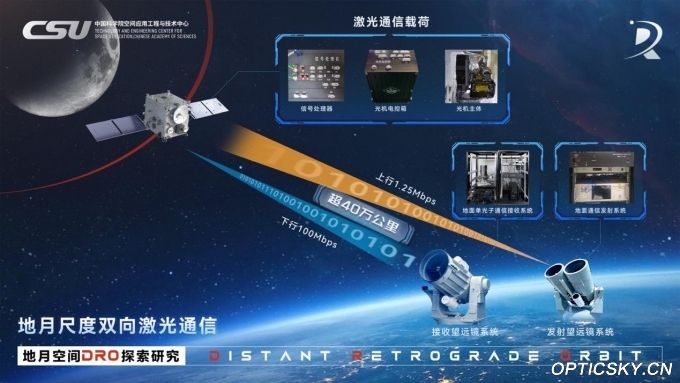
Schematic diagram of bidirectional laser communication at Earth-Moon scale
The first challenge lies in beam pointing. Earth-Moon laser communication is analogous to threading a fast-moving needle with a narrow light beam from 400,000 km away. Tiny angular deviations at the transmitter translate into positioning errors of several kilometers at the target. The research team developed a novel pointing strategy, accounting for satellite orbits, telescope alignment errors, atmospheric refraction and laser time-of-flight, to keep the space-borne satellite and ground telescopes locked on target during motion.
Once pointing was solved, another obstacle emerged: after traveling 400,000 km, the laser signal weakens to just a handful of photons. Ground telescopes capture very few valid photons amid interference from moonlight, starlight and urban lighting. The team deployed single-photon ultra-sensitive detectors and sophisticated signal identification algorithms to extract valid signals from heavy background noise, comparable to detecting a pin drop amid noisy crowds from far away.
High data throughput was also achieved through optimized data processing. The test demonstrated an uplink rate of 1.25 Mbps and a downlink rate of 100 Mbps. Yang Lei explained: downloading an 8K high-resolution lunar image takes roughly 4–5 minutes over conventional 5 Mbps microwave links, while the 100 Mbps laser link completes the transfer in only around 12 seconds.
“This Earth-Moon information highway is now open, enabling us to acquire more original scientific data in the future,” said Yang Lei. The technology will deliver high-speed data transmission for China’s crewed lunar missions, lunar science station construction and deep-space exploration.
Led by the Center for Space Application Engineering and Technology, CAS, the mission involved the Zhejiang Lab, Yunnan Observatories, CAS, and the Shanghai Institute of Microsystem and Information Technology, CAS. The experiment was carried out using satellite DRO-A operating in a Distant Retrograde Orbit.