










- Windows
- Prisms
- Spherical Lenses
- Cylindrical Lenses
- Mirrors
- Beamsplitters
- Polarization Optics
- Singlet True Zero Order Waveplate
- Cemented True Zero Order Waveplate
- Cemented Zero Order Waveplate
- Optical Contact Zero Order Waveplate
- Air-Spaced Zero Order Waveplate
- Low Order Waveplate
- Multi-Order Waveplate
- Narrow Band Polarization Beamsplitter Cube
- Broadband Polarization Beamsplitter Cube
- Rotator
- Glan Taylor Polarizer
- Glan Laser Polarizer
- Glan Thompson Polarizer
- Glan Thompson Polarization Beamsplitter Cube
- Wollaston Polarizer
- Rochon Polarizer
- Broadband Polarization Beam Combiner
- Brewster Polarizer
- Brewster Window
- Coatings






A research team led by Researcher Zhou Jiaqi from the Aerospace Laser Technology and Systems Department, Shanghai Institute of Optics and Fine Mechanics, Chinese Academy of Sciences, has made progress in noise studies of mode-locked neodymium-doped fiber lasers. The findings, titled *Noise characterization of the ~915 nm figure-9 mode-locked fiber lasers operating in dissipative and dispersion-managed soliton regimes*, were published in *Optics Express*.
Ultrafast lasers near 915 nm are highly valuable for bioimaging and optical metrology. The Nd-doped mode-locked scheme based on all-polarization-maintaining fiber nonlinear amplifying loop mirrors offers an effective route to compact, stable, high-performance 915 nm ultrafast sources. Nevertheless, noise characteristics under distinct mode-locking regimes remain largely unexplored. Intensity and phase noise of such lasers are critical for practical applications including material processing and optical metrology.
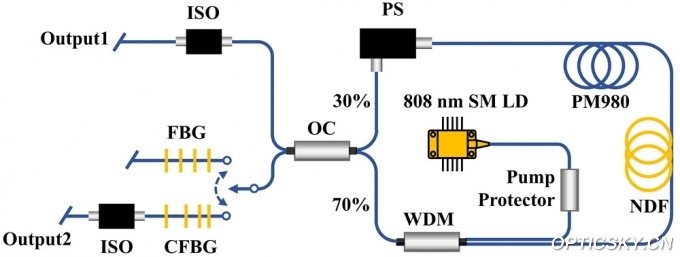
All-fiber figure-9 cavity Nd-doped mode-locked fiber laser
To address this gap, the team built two all-fiber figure-9 cavity Nd-doped mode-locked lasers operating in dissipative soliton and dispersion-managed soliton regimes respectively. They systematically measured and compared relative intensity noise (RIN) and repetition-rate phase noise, and analyzed noise sources across different frequency bands.
Experiments show that the dispersion-managed soliton laser suppresses intensity noise via strong self-amplitude modulation saturation, yielding an integrated RIN of only 0.019%. Weak time-frequency coupling between noise components also keeps its integrated phase noise as low as 0.04 rad. By contrast, the dissipative soliton laser achieves an integrated RIN of 0.035% through intracavity narrowband filtering. However, its large pulse chirp and broad pulse width result in a high integrated phase noise of 1.51 rad.
This work provides scientific guidance for matching mode-locking mechanisms to specific application scenarios and will promote the deployment of ultrafast Nd-doped fiber lasers in bioimaging, optical metrology and other cutting-edge fields.
The research was funded by the National Key R&D Program and the National Natural Science Foundation of China.